Patch It Again or Start Fresh? The Honest Maths Behind Gutter Repairs vs Replacement
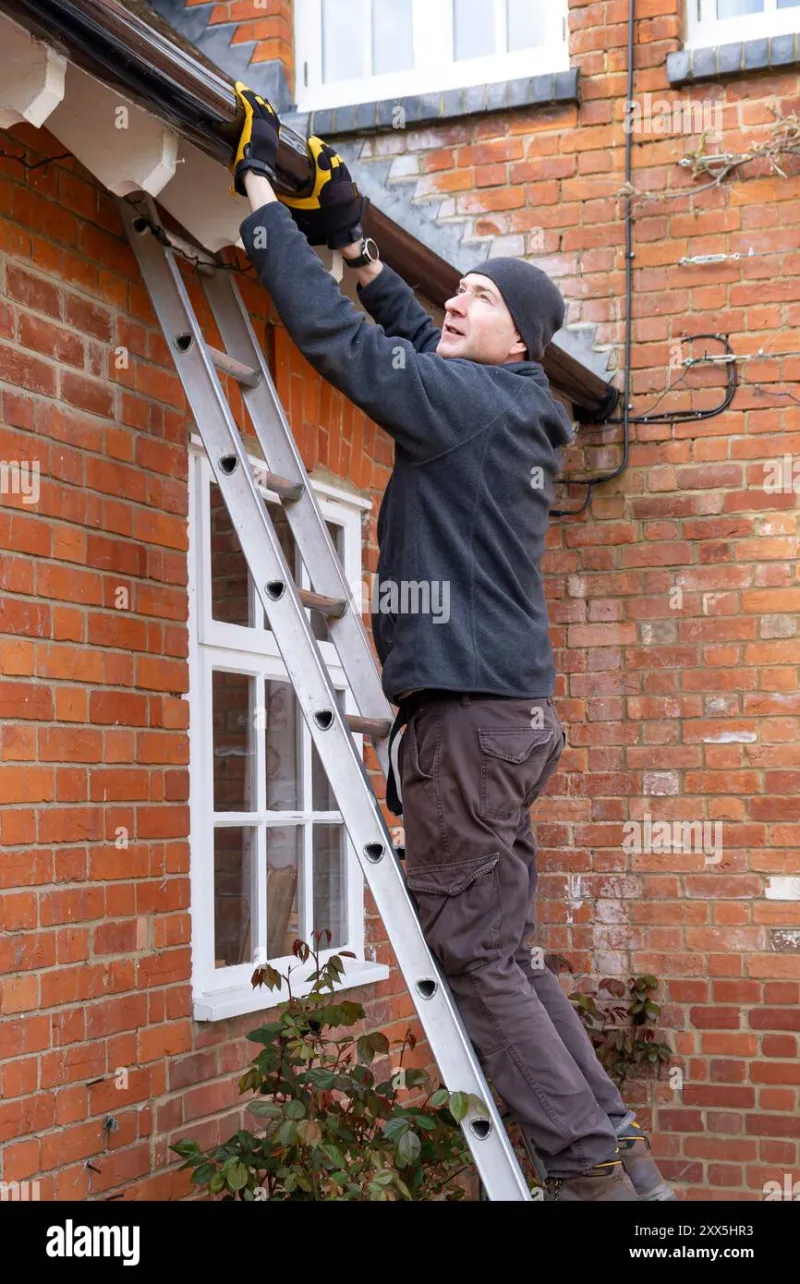
Photo: gutter repair ladder uk house roofline, via c8.alamy.com
We get a particular kind of phone call at this time of year. It goes something like this: "We've had someone out to that same joint three times now. It keeps leaking. Are we throwing good money after bad?"
It's a fair question, and it deserves a fair answer — not a sales pitch. So here's how we genuinely think about it, and how you can too.
The Three Strikes Rule (Roughly)
There's no law of guttering that says three repairs means replacement, but it's a decent rule of thumb. A single failed joint on an otherwise sound run of uPVC? That's a repair, every time. A bracket snapped loose after a storm? Repair. A downpipe blocked by a tennis ball and fifteen years of moss? You know the answer.
But when the same section keeps failing — a different joint each winter, or worse, the same joint we sealed last autumn — that's your guttering telling you something. Plastic becomes brittle with age and UV exposure. The clips lose their grip. Sealing a brittle joint is like putting a plaster on a biscuit.
Signs It's Beyond a Patch-Up
Some things we see on ladders that immediately change the conversation:
- Sagging runs. If a length of gutter dips between brackets, the fascia behind it is often rotten or the brackets have perished. Fixing one without the other is a temporary reprieve at best.
- Hairline cracks along the lengths themselves, not just the joints. Plastic doesn't crack in one spot for no reason — it cracks because it's tired all over.
- Seam leaks on old sealed systems. Older uPVC and cast iron setups rely on seals along every seam. When those start going, they tend to go in dominoes.
- Repeated standing water. If the gutter holds water even after cleaning, the falls have gone wrong — often because fixings have moved. Re-aligning works once or twice; beyond that, the whole run usually needs re-hanging.
The Money Question, Answered Plainly
Let's talk numbers, because vague warnings are no use to anyone. These are ballpark figures for a typical semi — your quote will depend on access, height and how much scaffolding the job needs.
A straightforward repair — replacing a joint, a short section, a few brackets — typically runs £80 to £200. Replacing a full run of guttering on the front or back of a house might be £300 to £600. A whole-house replacement, gutters and downpipes, generally lands somewhere between £800 and £1,500 for uPVC on an average semi.
So here's the maths we run through with customers: if you've spent £150 on repairs in each of the last two years, and the same problems are creeping back, you're halfway to the cost of a new run already — with nothing to show for it but another winter of watching the same drip.
When Repair Is Genuinely the Right Call
We won't talk you into a replacement you don't need. Honestly, most of our work is still cleaning and repairs, because most guttering isn't dying — it's just dirty or slightly loose.
Repair makes sense when the system is under fifteen years old, the problems are isolated to one or two spots, and the rest of the run sits true and drains freely. It also makes sense if you're selling soon and need everything watertight without a full refit.
And if you've got proper old cast iron that's seen a century of weather? Sometimes the right answer is specialist repair and repainting, not a skip. We'll always say so if that's your situation.
A Simple Framework for Your Own Decision
Ask yourself four questions:
- How old is the system? Under 15 years, lean repair. Over 20, lean replacement.
- Is it one problem or a pattern? One leak is a fault. Three leaks in different places is a trend.
- What have repairs cost so far? Add up the last two years. Compare it to a replacement quote.
- Do you trust the person on the ladder? A good tradesperson will tell you when a repair will do. If every visit ends with a hard sell, get a second opinion.
Our Bottom Line
Guttering isn't glamorous, and nobody wants to spend money on it. But there's a difference between spending money and wasting it. If your gutters are failing in more places than you can count on one hand, and the repair bills are stacking up, replacing the tired sections is usually the cheaper option over five years — and you stop spending your Octobers listening for drips.
If you're on the fence, book a look-over. We'll tell you straight which camp you're in, even if the answer is "leave it alone for now."