When the Water's Coming From Next Door: Sorting Out Boundary Guttering Without a Row

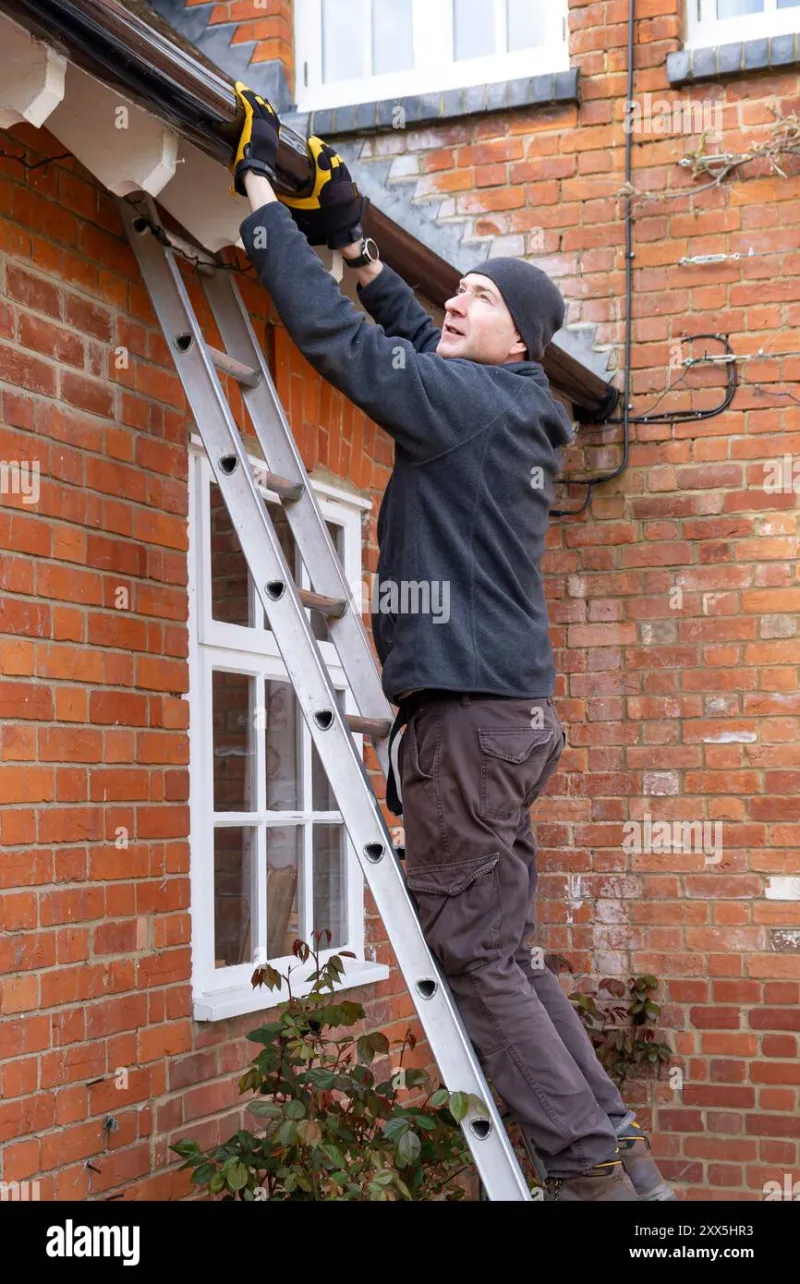
Photo: Michael Garlick , CC BY-SA 2.0, via Wikimedia Commons
We've spent years up ladders across the UK, and we can tell you that the hardest part of a boundary gutter job isn't the working at height or the stubborn fixings. It's standing in someone's garden, trying to work out whose gutter is actually dripping, and then helping two neighbours have a conversation neither of them wanted to have.
If water is pouring off the joint between your roof and next door's — or worse, soaking into the wall of your extension — here's how to untangle it without falling out with the person whose bins you'll be wheeling past for the next twenty years.
First Things First: Whose Gutter Is It, Actually?
Most of the time, ownership follows the roof. If the gutter is fixed to your neighbour's fascia and catches rain from their roof slope, it's theirs — even if it hangs over or discharges near your property. Gutters don't respect the boundary line on the deeds; they sit wherever the builder put them, sometimes decades ago.
That said, it's not always obvious. On terraced streets, it's common to find shared downpipes that serve two or three houses, gutters that meet at a valley right on the property line, and older properties where previous owners have rejigged the drainage entirely. If you genuinely can't tell, the title deeds or a quick look at the Land Registry plan can help — but honestly, a decent gutter firm can usually tell you in five minutes just by tracing where the water comes from.
One thing worth knowing: if a gutter physically straddles the boundary, both owners may have rights and responsibilities over it. That's where things get interesting.
The Party Wall Question
People often assume the Party Wall etc. Act 1996 covers gutters. It mostly doesn't — the Act is about walls, excavations and building work on or near the boundary. But it matters in one practical way: if a repair requires fixing a gutter to a wall that sits on the boundary (a party wall), you can't just start drilling without consent. If your gutter job means working on or from the neighbour's side, a friendly word — or formal notice, if things are frosty — is the right route.
The good news? The vast majority of boundary guttering issues never get anywhere near a surveyor. They get sorted with a cup of tea and a shared quote.
When Their Leaking Gutter Is Wrecking Your Wall
This is the scenario we see most: the neighbour's gutter has failed, and the water is running down your brickwork. Left alone, that means damp inside, damaged pointing, rotten window frames and, on extensions with modern renders, some genuinely expensive repairs.
Your neighbour isn't obliged to maintain their gutter to a schedule — there's no law saying "clean your gutters every spring" — but if their disrepair is causing damage to your property, you do have options. In England and Wales, nuisance law can come into play: you can ask them to fix it, and if they refuse, you can ultimately seek an abatement notice through the council or pursue a civil claim. Scotland has similar provisions under the Tenement Management Act and common law.
But here's our professional advice, earned the hard way: don't open with solicitors' letters. Open with a conversation.
How to Raise It Without Starting a Feud
A few tips that have kept more neighbourly peace treaties alive than we can count:
- Lead with the problem, not the blame. "There's water coming down where our roofs meet — do you want to come and have a look?" lands far better than "Your gutter is ruining my house."
- Offer to sort the access. Often the neighbour's gutter can only be reached from your garden or vice versa. Being helpful about access makes cooperation easy.
- Get one quote for the whole job. Two separate firms doing two separate halves of a valley gutter is false economy. One contractor, one price, one point of accountability.
- Split it sensibly. If the gutter serves both roofs, a 50/50 split is the obvious answer. If it's clearly theirs but the fix benefits you too, most people are happy to chip in a bit. Cheap insurance, really.
- Put it in writing after, not before. A friendly email confirming what you've agreed avoids "that's not what I said" moments later.
When to Just Get On With It Yourself
Sometimes the pragmatist's answer wins. If the repair is small — a leaking joint, a bracket, a short section of gutter — and the cost of arguing exceeds the cost of the fix, plenty of homeowners simply pay for it and mention it to the neighbour afterwards. More often than not, the neighbour offers to go halves anyway, or reciprocates down the line. Goodwill has a funny way of balancing the books on a street.
Just be careful about one thing: if you repair guttering on a neighbour's property, you're doing so at your own risk, and you may need their permission to access it. A verbal OK and a note of the date is usually plenty between reasonable people.
What We'd Do
If we were called out to a boundary job, here's the playbook: trace the water source properly (it's often not where it looks like — water travels along gutters and emerges a surprising distance from the fault), photograph everything, give both parties the same written quote, and keep the repair simple. Nine times out of ten, a couple of hundred pounds and one afternoon later, both walls are dry and both parties are still speaking.
Boundary guttering is one of those jobs where the technical work is the easy part. Handle the human side with a bit of humour and generosity, and the water — like most things in life — finds its proper course.
If you've got a drip coming from the wrong side of the fence and don't know where to start, give us a ring. We're happy to look at both sides, give an honest assessment of whose gutter it is, and quote for the lot — no fuss, no taking sides.